
Welcome to E-IPER's Winter Newsletter, highlighting the work of our students and faculty:
Silver Lining in the Climate Cloud- Business students explore market opportunities to reduce carbon emissions
Teach Your Children- Memorial service for Stephen Schneider emphasizes the future
Got Breadfruit?- Can an ancient food staple feed the world?
Melting Glaciers, Dying Trees- Climate change damages Alaskan forests
A Passion for Place- Students write creatively about their field sites
Silver Lining in the Climate Cloud
Personal mobility electric vehicles, traffic congestion pricing, and small modular nuclear reactors each represent a future market opportunity in a carbon-constrained world. Keen to take advantage of these prospects, E-IPER's Joint MS students from the Graduate School of Business (GSB) used their Capstone Projects to develop business plans and public policy ideas.
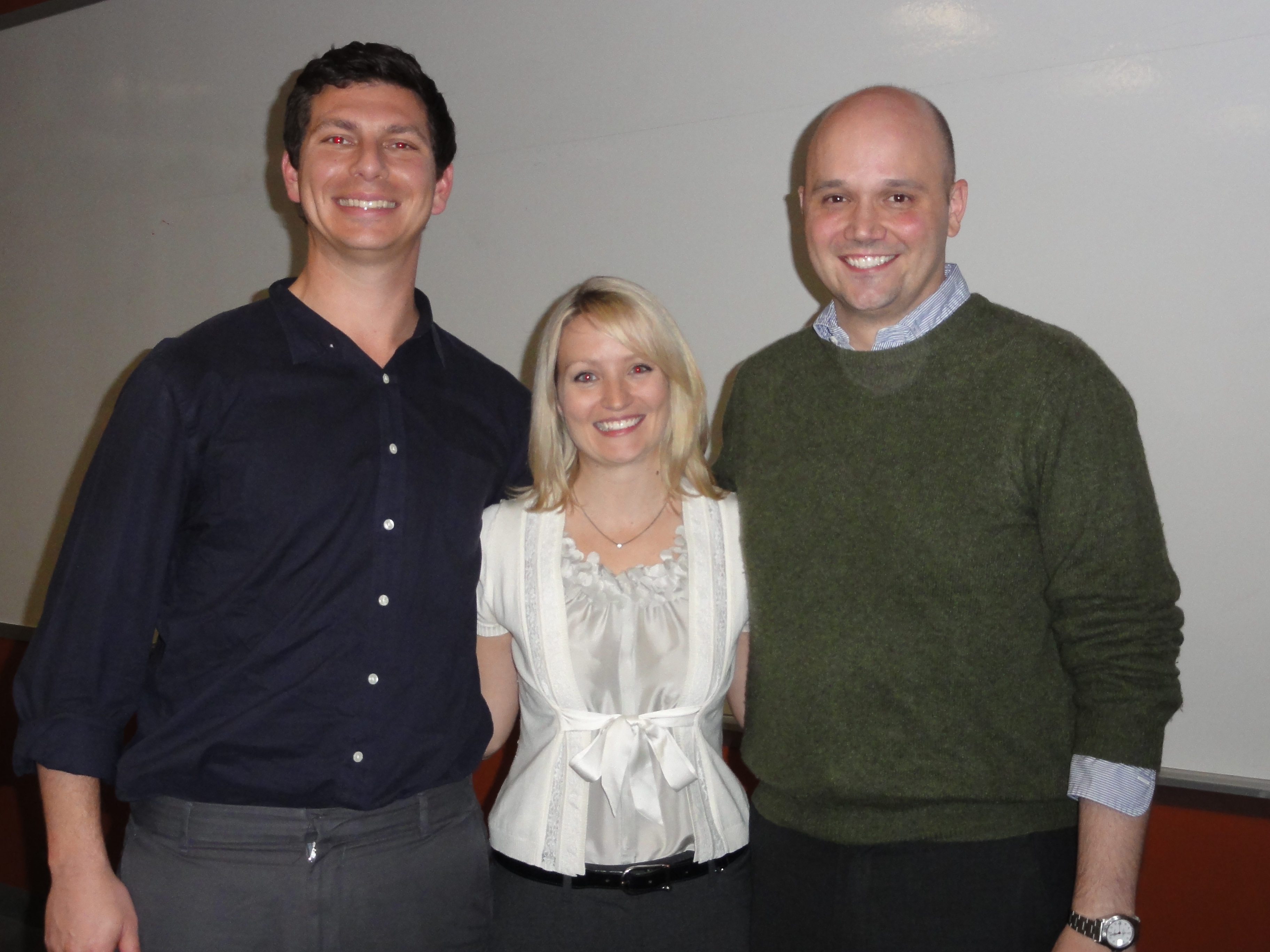 Joint MBA-MS students Graeme Waitzkin, Megan Guy, and Eli Gregory.
Working with start-up company Weng Motors, Graeme Waitzkin (Joint MBA-MS 2010) evaluated opportunities to market their new low-range electric vehicle as a replacement for gas-combustion engine cars in his project, Local Personal Mobility: The Role of the Low Range Electric Vehicle. Also in the transportation sector, Elijah Gregory (Joint MBA-MS, 3rd) assessed several policy options for reducing traffic congestion and carbon emissions. His project, Congestion and Greenhouse Gases: The Potential of Congestion Mitigation Strategies to Reduce CO2 Emissions, also considered ways to generate revenue to fund mass transportation and other transportation infrastructure improvements. On the energy generation front, Megan Guy (Joint MBA-MS 2010) analyzed the current political, environmental, security, and economic climate for deploying new nuclear reactors for carbon free energy generation in her project, Paper or Practical? Evaluating the Prospects for Small Modular Nuclear Reactors in the US.
In December, Graeme, Elijah, and Megan presented the results of their Capstone Projects to the E-IPER community at the second Feigenbaum Nii Foundation Symposium. Megan Guy was awarded the Feigenbaum Nii Foundation Prize for her interdisciplinary excellence and superior integration of science, engineering, and technology with her professional training in her Capstone Project. The students' presentations may be viewed online and are also discussed in a GSB news story.
Teach Your Children
Laughter and music permeated the recent memorial service for Stephen H. Schneider, who passed away unexpectedly in July. Steve would have appreciated the stories from his students, family, friends, and colleagues, and would have laughed heartedly along with them. The personal sharing of many facets of his life and influence by many attendees- from his children to several members of the Obama administration- created a feeling of intimacy, though the audience reached over 500. Steve had a way of making everyone feel important to him, international dignitaries and university staff alike.
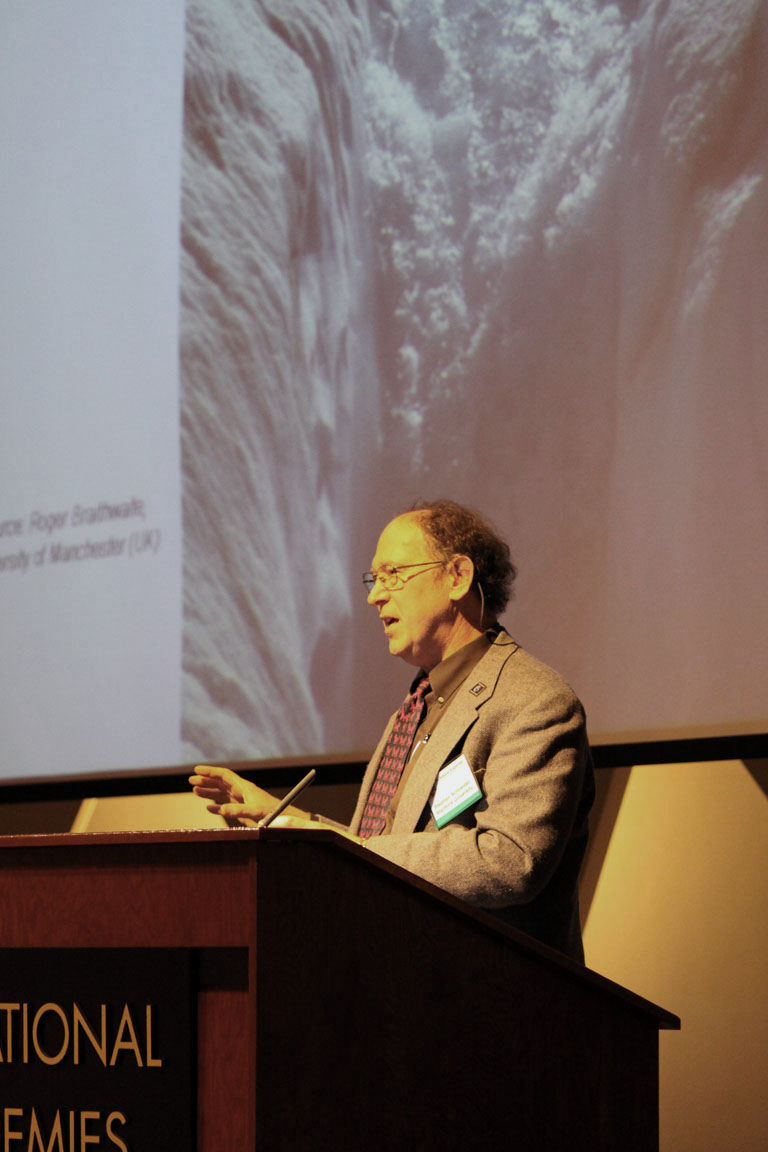 Schneider at a Climate Summit, 2009. Courtesy of Patricia Pooladi, National Academy of Sciences.
In keeping with Steve's tireless energy as a climate warrior, the service also gave ample attention to the seriousness of climate change and the urgent need for politicians, the public, and the media to understand and act on this very real threat. In their featured talks, John Holdren, Naomi Oreskes, and Jon Krosnick each honored Steve's impact on their work and on the world at large, reinvigorating the call to action so many had heard from Steve and who now must take over the job Steve was doing.
The memorial ended with a heartfelt rendition of Crosby, Stills, Nash, and Young's iconic 1970's song, Teach Your Children, played and sung by Steve's friends and family on stage and joined by the audience. A sweet and simple message to carry Steve's legacy forward.
Steve was co-director of E-IPER from 2003-2005 with Rob Dunbar, who became founding director in 2001. Read a longer description of the December 12 memorial service by Rick Piltz of the Climate Science Watch and tributes to Steve from E-IPER students.
Got Breadfruit?
Noa Lincoln (PhD 3rd) joins a large interdisciplinary project, Ho'oulu na 'Ulu, focused on increasing breadfruit's (Artocarpus altilis) share of world food production. As an underexploited food source, breadfruit is not often known outside of the famous film Mutiny on the Bounty. For centuries an essential food for several indigenous cultures, breadfruit trees produce a starchy fruit high in vitamins and minerals that can be used in a striking range of dishes. Breadfruit trees are hugely productive, yielding several hundred fruits a year, each weighing upward of seven pounds. Thus one tree can produce over 1,000 pounds of food annually, enough to feed a four-person family.
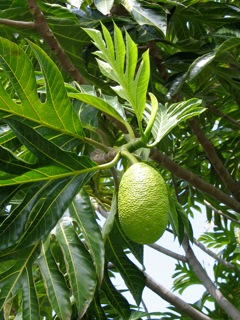 Breadfruit on the tree. Courtesy of Noa Lincoln.
Food production from tree crops such as breadfruit is particularly important in areas with limited soil fertility, such as Africa and the Amazon, where traditional crops like corn and wheat are so destructive to the soil that farming cannot persist for more than a few years. In contrast, tree crops can significantly reduce- and in some cases even reverse- the effects of erosion and nutrient depletion, making breadfruit an environmentally sustainable and healthy food source. Tree crops can also be grown on steep slopes where many annual crops cannot.
Breadfruit has not become a worldwide food source largely due to reproductive challenges: breadfruit rarely produces seeds and must be reproduced via clones. Diane Ragone, director of the Breadfruit Institute for the National Tropical Botanical Gardens and a leading breadfruit researcher, recently resolved this reproductive barrier to commercial production through micro-propagation. With the potential to rapidly expand breadfruit production, the thirty-person Ho'oulu na 'Ulu team is contemplating a wide range of strategies.
Academics, aided by Noa Lincoln, are studying the relationship between production and environmental parameters in order to estimate production in different global areas. Land managers are considering ways to incentivize growing breadfruit on their lands, and educators and marketers are formulating a large-scale public awareness campaign. A team of chefs and culinary associations are actively developing high-end culinary uses for breadfruit, while distributers are looking into the product's supply chain requirements to distribute the food worldwide.
Look for breadfruit in your local markets and produce boxes soon!
Congratulations to Our Autumn Quarter Joint MBA-MS Graduates
Sumi Kim, Brenden Millstein,
and Graeme Waitzkin
Notable Events
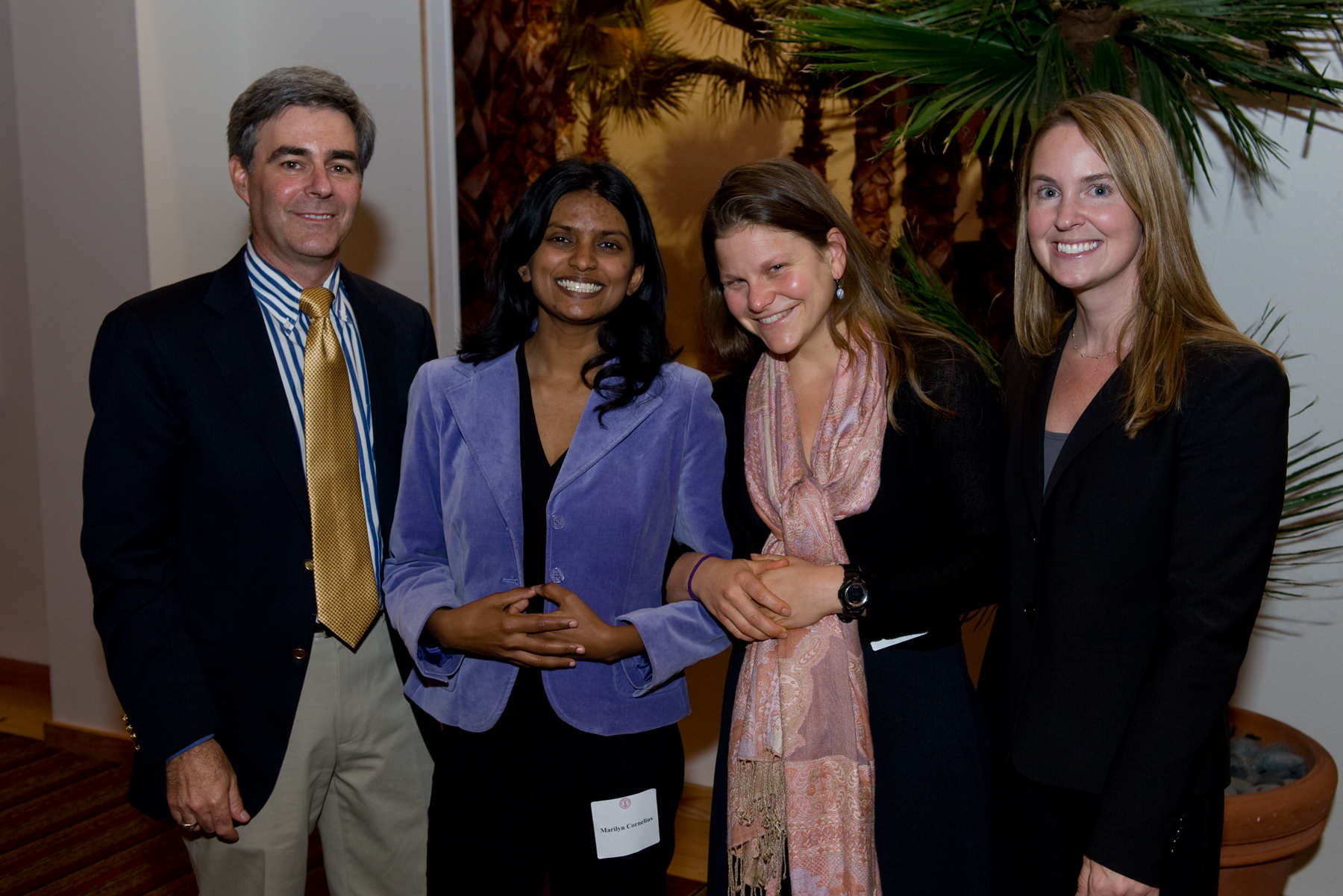 Tom Robinson, Marilyn Cornelius, Rachelle Gould, and Nicole Ardoin.
November 9, 2010
Marilyn Cornelius, PhD 4th
Lead advisors: Nicole Ardoin, Education and Tom Robinson, Medicine
Rachelle Gould, PhD 4th
Lead advisors: Gretchen Daily, Biology and Nicole Ardoin, Education
Marilyn dedicated her fellowship to the late Stephen Schneider and Terry Root and wrote a tribute to Steve, which was read by Professor Robinson.
Feigenbaum Nii Foundation Symposium
December 3, 2010
Featuring presentations of our Joint MS Students' Capstone Projects
Watch the presentations on video and read the highlights to the left.
Chi Conference
January 14, 2011
Sponsored by the Woods Institute for the Environment to promote innovative dialogue between environmental researchers across Stanford's seven schools.
E-IPER presenters: Hilary Boudet, PhD 2010, advisory board member Marilyn Cornelius, PhD 4th, Amanda Cravens, PhD 2nd, Dane Klinger, PhD 3rd, and Veena Srinivasan, PhD 2009
E-IPER attendees: Rachelle Gould, PhD 4th, Noa Lincoln, PhD 3rd, and Nicola Ulibarri, PhD 1st
Nicole Ardoin, Education, chaired the Chi Conference and Marilyn Cornelius, PhD 4th, served on its Advisory Committee.
Publications
Rachelle Gould, PhD 4th: 'Malama the 'aina, Malama the people on the 'aina': The Reaction to Avatar in Hawai'i, Journal for the Study of Religion, Nature and Culture, 2010, with Nicole Ardoin Education, and Jennifer Hashimoto University of Hawai'i at Hilo.
Amy J. Pickering, PhD 4th: The Effects of Informational Interventions on Household Water Management, Hygiene Behaviors, Stored Drinking Water Quality, and Hand Contamination in Peri-urban Tanzania, American Journal of Tropical Medicine and Hygiene, 2011, with Alexandria Boehm CEE and Jenna Davis CEE.
Caroline Scruggs, PhD 5th: Collaborated with International Chemical Secretariat on a report, Information on Chemicals in Electronic Products: A study of Needs, Gaps, Obstacles, and Solutions to Provide and Access Information on Chemicals in Electronic Products, 2010.
Adam Millard-Ball, PhD 5th: Adverse Selection in an Opt-in Emissions Trading Program: The Case of Sectoral Crediting for Transportation, Stanford's Program on Energy and Sustainable Development (2010 working paper).
Presentations and Posters
Creating Safer Consumer Products: The Information Challenges Companies Face, Lund University Centre for Sustainability Studies, Lund University, Sweden, November 2010.
Amy J. Pickering, PhD 4th:
Fecal Contamination on the Hands of Tanzanian Mothers Varies Temporally and Following Household Activities: Implications for Measuring Handwashing Behavior, Water and Health: Where Science meets Policy, University of North Carolina Chapel Hill, October 2010; and American Society for Tropical Medicine and Hygiene annual meeting in Atlanta, GA, November 2010.
Adam Millard-Ball, PhD 5th:
presented two papers at the Transportation Research Board Annual Meeting in January in Washington, DC: Reducing CO2 Through Sectoral Crediting: The Challenges of Adverse Selection, and Do City Climate Plans Reduce Transportation Emissions?
Marilyn Cornelius (PhD 4th):
presentation on Energy Behavior and Ethnography, with Carrie Armel (Precourt), and a poster on Global Identity and Sustainability Related Attitudes and Behaviors, as a factor influencing sustainability related attitudes and behaviors, Behavior, Energy, and Climate Change Conference, Sacramento, CA, November 2010.
Noteworthy Achievements
Lauren Oakes, PhD 2nd, received a Community Engagement Grant from Stanford's Haas Center for Public Service to support her research on forestry and climate change in Alaska.
Caroline Scruggs, PhD 5th, collaborated with the Swedish industry association Teknikföretagenon a survey of members' needs and uses of chemicals-related information for product design and manufacture.
The Sound Advice for Green Earth (SAGE) column, led by Tom Hayden, E-IPER, is now being distributed through multiple sources: Stanford magazine, SAGE's first outlet, and via the graduate journalism program's Peninsula Press project, to the San Francisco Chronicle and Bay Citizen websites. Submit your own sustainability questions here.
New Courses
Austin Becker, PhD 3rd, in collaboration with Meg Caldwell, Law, is leading a new course this winter, Our Coastal Society: An Interdisciplinary Seminar on ocean/coastal themes.
Tom Hayden, E-IPER, is piloting a new course, Reporting From the Field: Digital Storytelling for Scientists, to help students present their research in multi-media formats.
Marilyn Cornelius, PhD 4th, is designing a new Design and Behavior course with Banny Banerjee, Mechanical Engineering, for Spring 2011.
Alumni Updates
Linh Pham, MS 2007, founder and managing director of Gratia Recycling, received a Social Entrepreneurs Support Program Start-Up Level Award. She also attended COP16 in Mexico as a Climate Champion selected by the British Council.
Hilary Schaffer Boudet, PhD 2010, postdoctoral fellow at Stanford Prevention Research Center, has a book with Doug McAdam, Sociology, under review at Cambridge University Press: Putting Social Movements in Their Place: Explaining Opposition to Energy Projects in the United States, 2000-2005; and a paper in press: Drivers of Conflict in Global Infrastructure Projects: Experience from the Water and Pipeline Sectors, Journal of Construction Engineering and Management, with S.D. Jayasundera and Jenna Davis, CEE.
Read more about the students and faculty mentioned in these stories on our website.
The E-IPER Newsletter is edited by Helen Doyle, designed by Katie Phillips, and produced by Haley Smith Kingsland and Katie Phillips.
Melting Glaciers, Dying Trees
In conjunction with the USDA Pacific Northwest Research Station Forestry Sciences Laboratory (FSL) in Juneau, Alaska, Lauren Oakes (PhD 2nd) is currently designing an ecological study to understand changes in the coastal forest community, as a response to Yellow-cedar decline. By reducing the snowpack that acts as an insulator to protect roots throughout the frozen winters, climate change has made the trees vulnerable to sudden freeze-thaw events, resulting in mortality spreading from British Columbia to Southeast Alaska.
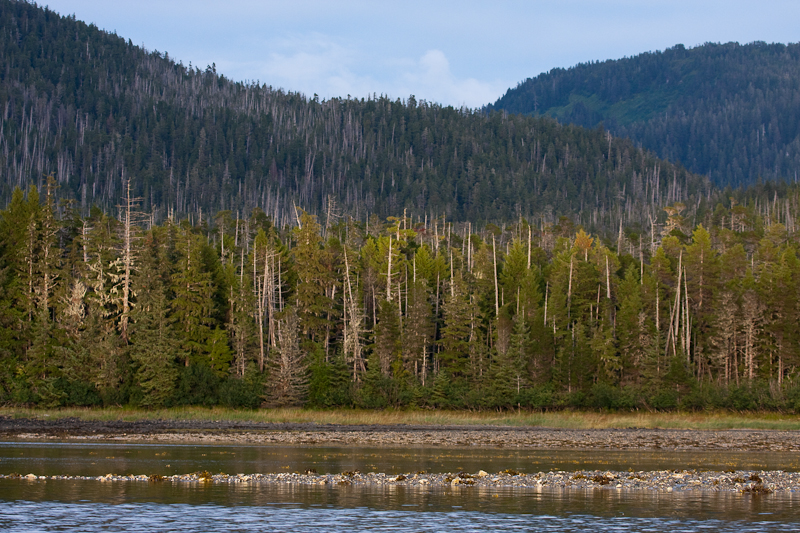 Peril Strait, near Chichagof Island. Courtesy of Jonathan Felis.
Lauren will consult historical aerial photographs to verify the timing of Yellow-cedar mortalities, and collect data on the presence and growth of other tree species to aid in interpreting forest response to Yellow-cedar death. She will visit forests that died off in the early 1900s and compare her observations to those found in forests of more recent die-offs.
In addition to its scientific contributions, Lauren's research will yield implications for the management of these forests for multiple uses and for conservation planning. Her research will bring together community members from the Sitka Conservation Society to the local Forest Service Ranger district. Along with FSL, Lauren hopes to engage local college students and educators in the project. "I'm looking forward to a busy summer and keeping my fingers crossed for favorable winds to access these remote forests. I'm excited to build a team to work on this project over the coming years."
A Passion for Place
Immersed in the field for months, E-IPER students often become passionate about the places and people that contribute to their research. To channel this passion creatively, Tom Hayden, E-IPER lecturer, offered students a writing workshop, Writing Place, in spring 2010. Below Rachael Garrett (PhD 3rd) and Kim Carlson (PhD 5th) describe their field sites and motivations driving their research, in Brazil and Indonesia, respectively.
I study the economic and institutional determinants of soybean production, agribusiness, and land use in Brazil. To develop a more holistic understanding of these issues I incorporate multiple spatial scales in my analysis, including local case studies, regional modeling, and macroeconomic analysis. In my fieldwork in the Brazilian Amazon, I am struck by how dramatically the land is transformed for soybean production.
- Rachael Garrett
No Man Loves This Land
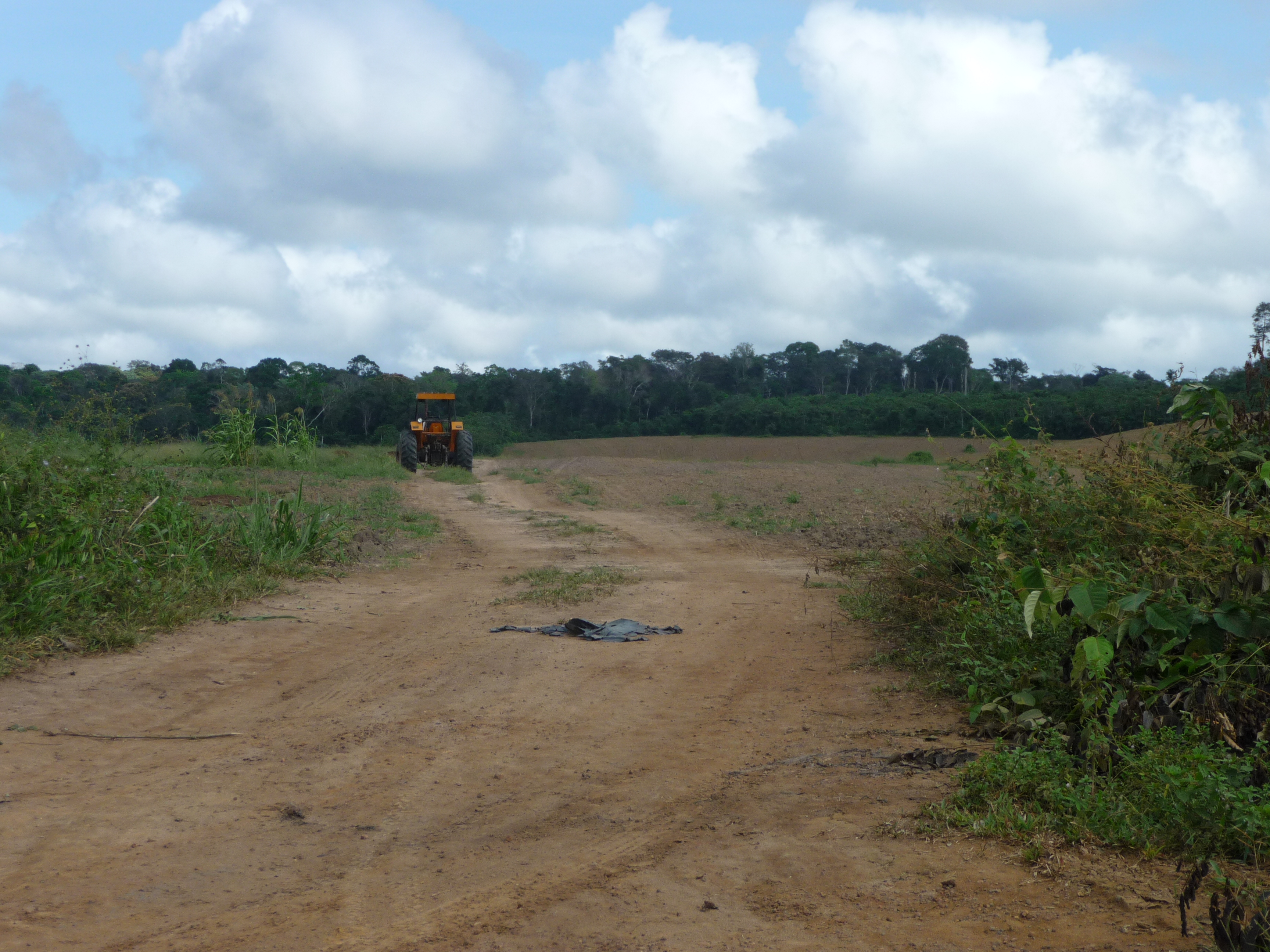 Soybean farmland in Brazil. Courtesy of Rachael Garrett.
No man loves this land.
Machines armed with chains rip trunks from the earth, suffocating a hundred of years of life in moments. The canopy topples down.
The light is too much. All that is green and beautiful, now garbage, unwanted.
What remains is red clay. Toxic, aluminum, acidic, and thin. We can use this. It will be our new currency. Truck in the lime. Pour on the phosphorus. Level it out. It is ours.
Bowing down to the man in the tractor cage. She feels his weight and takes his seed. Row upon row.
Located in Kalimantan (Indonesian Borneo), the Pawan River drains to the Java Sea at Ketapang, the second largest port city in the West Kalimantan province, and is a major transport route for timber, rubber, and palm oil. In my dissertation, I investigate the effects of oil palm plantation expansion on land use and livelihoods in this region of Borneo. While in the field, I often stay with people who live on the banks of the Pawan.
- Kim Carlson
Sungai Pawan
The river rests at night, whether the moon shines or the rain pours in the damp tropical dark. At midnight she likes to play tricks.
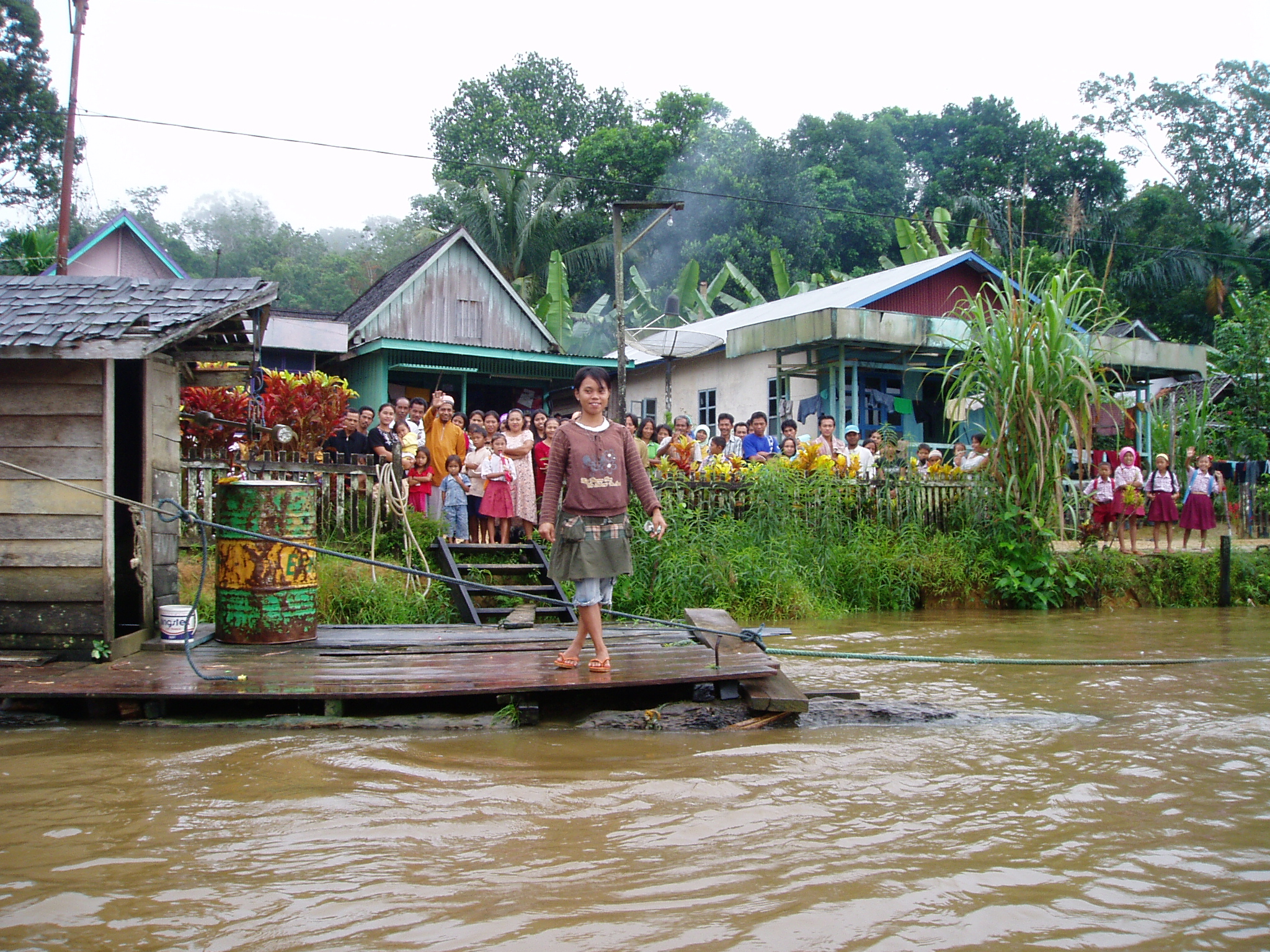 People along the Pawan River. Courtesy of Kim Carlson.
She is not ashamed to flood, sending Charlie and the Chocolate Factory-brown water onto lawns and road. If she is feeling particularly naughty, villagers wake to find water knocking at front doors. On lazier evenings, she playfully dislodges unsuspecting human belongings: a fishing net, a canoe. Unlike many of her brethren, this river is untamed - just a handful of bridges scale her flanks, and no dams break her flow. Left to carve her own path, she constantly remodels, eroding and constructing steep vertical banks, tirelessly holding water - a trickle, a torrent - away from dry land.
To learn more about E-IPER, visit e-iper.stanford.edu. To subscribe or unsubscribe, email your request to Helen Doyle: hdoyle@stanford.edu.